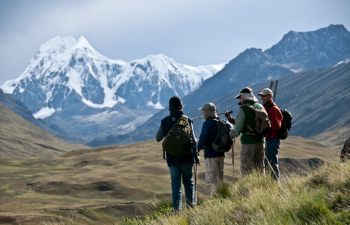
LATA webinar: Beyond the Trail – Selling adventures in Peru
This webinar, led by Aldo Parodi, Director of PROMPERU UK & Ireland, focused on off-the-beaten track adventure,
Martin Romero, General Manager of Explorandes, Peru’s pioneering adventure tour operator, focused on largely-unknown adventure locations and immersive travel experiences that contribute to local community development and the conservation of natural and cultural heritage sites.
Paul Cripps, owner of Amazonas Explorer, based in Cusco since 1996, with 30 years’ experience exploring Peru by kayak, mountain bike, raft, canoe, stand-up paddle board and on foot, focused on alternative, less-crowded areas and trails to Machu Picchu, explored on foot, raft and bike.
Ten Key Takeaways
Ancash was named the world’s best adventure tourism destination by UN Tourism’s General Assembly in Riyadh last year and is now more accessible thanks to a new airport with daily flights from Lima.
Ancash offers three main trekking areas: Huayhuash (a compact, technical 12-day circuit or 6-day “Best of Huayhuash” version), Huascarán National Park (home to the Alpamayo and Santa Cruz treks), and the Great Inca Trail/Capac Ñan — a 150km, largely undiscovered stretch considered the best-preserved monumental great Inca Trail left in South America.
For older or less experienced trekkers (55+), the Santa Cruz trek (4 days/3 nights, easiest entry point) is recommended as the best starting option, progressing to Best of Huayhuash, then the longer Alpamayo or full Huayhuash circuits.
The Inca Trail to Machu Picchu is due to open this week after a landslide closure and the 5-day/4-night version over 4 days for is recommended for better acclimatisation and campsites.
Choquequirao is a strong Machu Picchu alternative and is larger than Machu Picchu but receives a fraction of the visitors. A 79-year-old client completed the trek and celebrated her 80th birthday there, showing it’s achievable for older travellers with proper acclimatisation.
Both companies are Certified B Corporations committed to sustainability. Explorandes partners with Regenera for carbon offsetting via forest conservation, while Amazonas Explorer offsets trips and plants trees.
Rafting the Urubamba/Ollantaytambo section near Cusco is strongly discouraged due to raw sewage contamination. Recommended are the cleaner Chuquicahuana or Piñipampa sections instead.
New/lesser-known adventure options are emerging near Cusco, including e-bike tours (Sacred Valley, Maras-Moray), the Apurímac River rafting (one of the true sources of the Amazon), and new sites like Pallay Punchu (a lesser-known Rainbow Mountain) and Tacraccasa (featured in National Geographic, larger than Machu Picchu).
Community interaction varies by trek and destination Some communities have long-standing tourism relationships (e.g., Amazonas Explorer’s tree-planting partnership in the Lares Valley since 2007), while others are less open to tourist engagement; biking trips tend to offer the most organic local interaction.
Licensing and operator quality matter significantly in adventure travel. Agents should verify that operators have proper licenses, as cutting corners on equipment and guides can create serious safety risks.
WATCH AGAIN HERE